At the heart of every injection-molded part is a machine that brings molten plastic to life: the plastic injection molding press.
This machine plays a critical role in shaping, cooling, and ejecting your finished component with speed and accuracy.
In this blog, we’ll walk through the basic mechanics of a plastic injection molding press, explain its key components, and show why the right press can make or break your manufacturing success.
But first, the basics…
What Is a Plastic Injection Molding Press?
A plastic injection molding press is a specialized machine used to produce high volumes of plastic parts by injecting molten resin into a metal mold. These presses range from compact benchtop units to massive industrial machines with clamping forces of hundreds of tons.
The core objective: to consistently produce plastic parts with precise dimensions, surface finishes, and mechanical properties.
Key Components of a Plastic Injection Molding Press
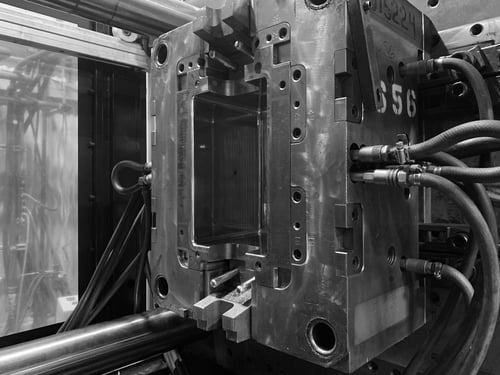
Understanding how a press works starts with knowing its main components:
- Clamping Unit: Holds the mold closed with sufficient force to counteract the pressure of injected molten plastic.
- Injection Unit: Heats, melts, and injects plastic material into the mold cavity.
- Mold: A custom steel or aluminum tool that forms the shape of your part.
- Ejection System: Pushes the cooled, finished part out of the mold.
These components work in unison during every cycle of production.
Want to dive deeper into the inner workings of the injection molding press machine? Check out this blog we did a few months back.
Why Plastic Injection Molding Press Selection Matters
The truth is that not all presses are created equal.
Choosing the right plastic injection molding press for your project impacts three key things:
- Part Quality: Proper tonnage, shot size, and clamping capacity help avoid warping, flash, and inconsistent dimensions.
- Cycle Time: Well-matched presses and molds reduce cooling time and improve throughput.
- Material Compatibility: Different resins flow and cool in unique ways, requiring specific pressure and temperature controls.
At Molding Dynamics, we operate both vertical and horizontal presses ranging from 75 to 700 tons—giving us the flexibility to match each job to the ideal machine for performance and efficiency.
Common Applications for Injection Molding Presses
Plastic injection molding presses are used to manufacture a wide range of parts, including:
- Medical housings and enclosures
- Consumer product components
- Automotive under-hood parts
- Electronics cases
- Industrial connectors and fasteners
The process is ideal for high-volume, tight-tolerance parts where consistency matters.
The Plastic Injection Molding Press Cycle: Step-by-Step
Let’s break down how a plastic injection molding press operates during a typical production cycle.
1. Mold Clamping
Before any plastic can be injected, the two halves of the mold (core and cavity) must close and lock securely. The clamping unit applies the necessary force to keep the mold sealed against the high-pressure injection.
Clamping force requirements vary depending on the part's size, material, and geometry. If the force is too low, flash (excess material) can escape around the parting line.
2. Plasticizing and Injection
Next, raw plastic pellets are fed into a heated barrel, where a rotating screw melts the material through friction and heat. Once molten, the screw advances forward, injecting the plastic into the mold at high pressure through a nozzle and runner system.
Proper injection speed and pressure ensure complete cavity filling without introducing defects like short shots or sink marks.
3. Cooling and Solidification
Once the mold is filled, the plastic must cool and solidify to its final shape. Cooling channels built into the mold help dissipate heat evenly and reduce cycle time.
Cooling accounts for the majority of the molding cycle, so optimizing this stage is crucial for production efficiency.
4. Mold Opening and Part Ejection
After the part cools, the mold opens. Ejector pins or plates push the finished part out of the mold cavity. In automated setups, robotic arms may collect the part and prepare the mold for the next cycle.
Then, the mold closes again, and the process repeats—often in cycles lasting just seconds.
Partner with Molding Dynamics for Your Plastic Injection Molding Needs
While we don’t build injection molding presses ourselves, our team knows how to engineer every part of the process – from mold design to material selection to matching your part with the right press. Whether you’re working on a prototype or ready for full-scale production, our engineering and production team helps ensure your part gets made right the first time and every time after.
Have questions about plastic injection molding presses or part feasibility? Want to get a quote?